
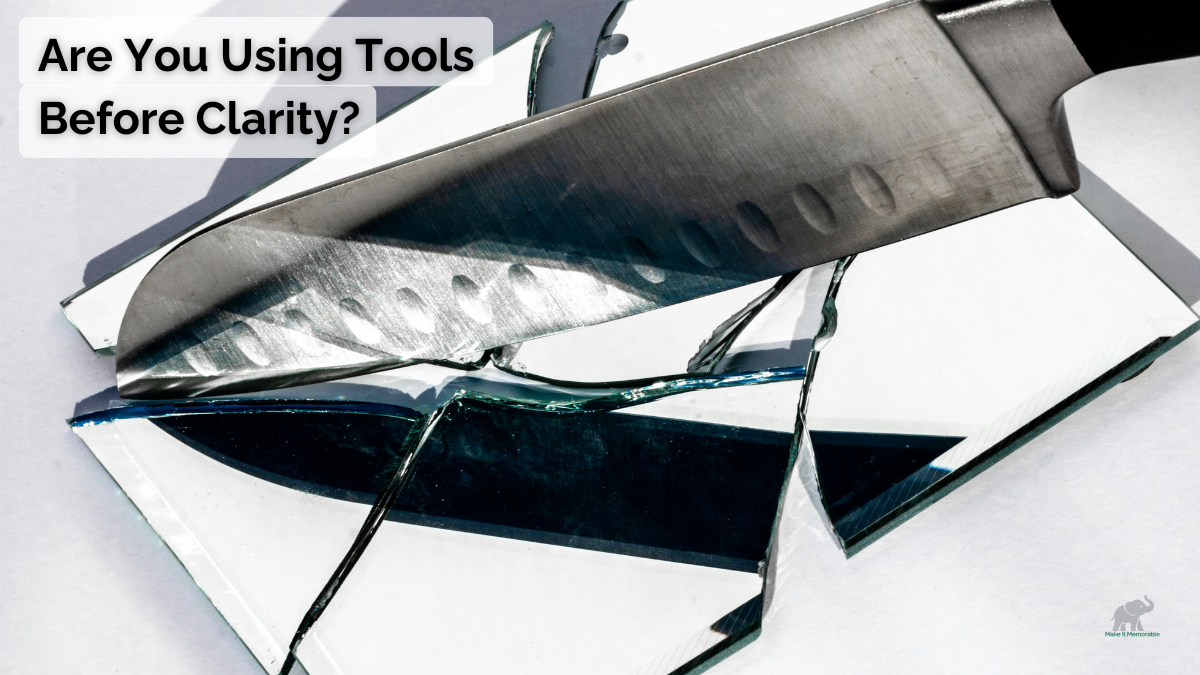
Last week, I wrote about what happens when businesses lose their sense of why: when wonder fades, and growth quietly slows.
The response confirmed something I’ve been seeing for a long time.
Many businesses don’t lose momentum because they stop trying.
They lose momentum because things start to feel heavier, noisier, and more complicated than they should.
And when that happens, there’s a very common instinct.
We add tools.
Let’s Pick Up Where We Left Off
When growth slows, or marketing starts to feel “off,” the signals are often subtle at first:
- Results feel inconsistent
- Messaging feels harder to articulate
- Effort increases, but traction doesn’t
The work itself hasn’t changed, but it feels louder. More fragmented. Less grounded.
When businesses lose their sense of wonder, the impulse is often to add tools.
But that’s rarely where the problem starts.
This is where we go one layer deeper.
The Common Reflex: Adding Tools When Things Feel Off
This response makes sense. It’s human.
When clarity wobbles, we look for something that feels solid.
Something actionable.
Something we can point to and say, at least I’m doing something.
So, we reach for what we usually call “tools”:
- New software
- New dashboards
- New automations
- New platforms
And to be clear, tools aren’t bad.
They promise control.
They promise certainty.
They promise speed.
They feel constructive.
But here’s the quieter truth beneath all of this:
What we often call “tools” isn’t just software anymore.
It’s anything that gives us the feeling of progress when clarity feels uncomfortable.
And that’s where the trouble starts.
What We Often Call “Tools” (Even When They Aren’t)
When people think of marketing tools, they usually picture software or platforms.
But the definition has quietly expanded.
Today, “tools” often include:
- Metrics & numbers (reach, engagement, CTR, conversions)
- Frameworks & formulas (funnels, hooks, content pillars)
- Templates & swipe files (pre-written email sequences, ad copy, carousel structures)
- Trends & tactics (“what’s working right now”)
- Advice (experts, gurus, comment-section consensus)
- Consistency itself (“just keep posting, don’t break the streak”)
And now, of course…
AI.
AI didn’t start this mindset, but it definitely accelerated it.
It’s increasingly treated as a shortcut to clarity.
Let’s automate it all, right?
Here’s the problem:
All of these are visibility tools. Not meaning tools.
They help you do things faster and more often, but they don’t tell you why those things matter.
When clarity is missing, everything becomes a tool — metrics, templates, trends, even AI — because structure feels more comfortable than uncertainty.
The Order Problem: Why Tools Fail Without Clarity
This is where growth quietly breaks.
Clarity answers questions like:
- Who are we actually trying to help?
- What problem are we known for solving?
- Why does this work matter?
Tools only answer:
- How often
- How many
- From where
When clarity comes first, tools amplify it.
When tools come first, they amplify confusion.
This connects directly back to last week’s conversation about wonder and why.
Clarity and wonder set the direction.
They define where you’re going and why the journey matters.
Tools and metrics simply tell you how you’re moving — how fast, how often, and by what route.
When the destination is unclear, changing vehicles doesn’t help.
What This Looks Like in the Real World
This isn’t theoretical. It shows up every day.
- Posting consistently but feeling invisible — like you’re shouting into the void
- Running ads that technically “work” but don’t convert — visibility without relevance
- Seeing traffic, but no meaningful engagement — visits without connection
- Feeling busy without momentum — like a hamster on a wheel
The data isn’t lying.
It’s just answering the wrong question.
The Reframe: Tools as Mirrors, Not Answers
Here’s the shift that changes everything.
Tools don’t create clarity.
They reveal what’s already there.
They’re diagnostic, not directive.
Your tools are telling a story, but clarity determines whether you know how to read it.
When you stop expecting tools to fix things and start using them to reflect things, the relationship changes. You stop chasing numbers and start listening to signals.
One Pause Before the Next Tool
Before adding another platform, framework, or automation, pause with this one question:
If someone found you today, could they clearly explain why your work matters — without you being in the room?
This isn’t an elevator pitch.
It’s something deeper.
Not what you do, but why it matters.
Returning to Order
Clarity before tools isn’t about doing less.
It’s about doing the right things in the right order.
Growth doesn’t come from more noise.
It comes from alignment.
Clarity → Message → Tools → Growth
Not the reverse.
This is the work I keep coming back to with clients — not because it’s flashy, but because it works.
And because when clarity leads, everything else finally has something solid to stand on.
If this reflection resonates, you don’t need more tactics. You may just need space to clarify what already matters.
That’s the work I keep coming back to — helping businesses reconnect with their direction before deciding how to move.
Because when clarity leads, the right tools tend to follow naturally.
Leave a Reply