
More Traffic Is Not Always the Real Solution
Business owners often assume that slow results mean they need more traffic. More views. More clicks. More reach. More followers.
And that can be true. But not always.
People may already be finding the business. They are landing on the website. They are checking the Google Business Profile. They are clicking over from social. They are looking.
They just are not moving forward.
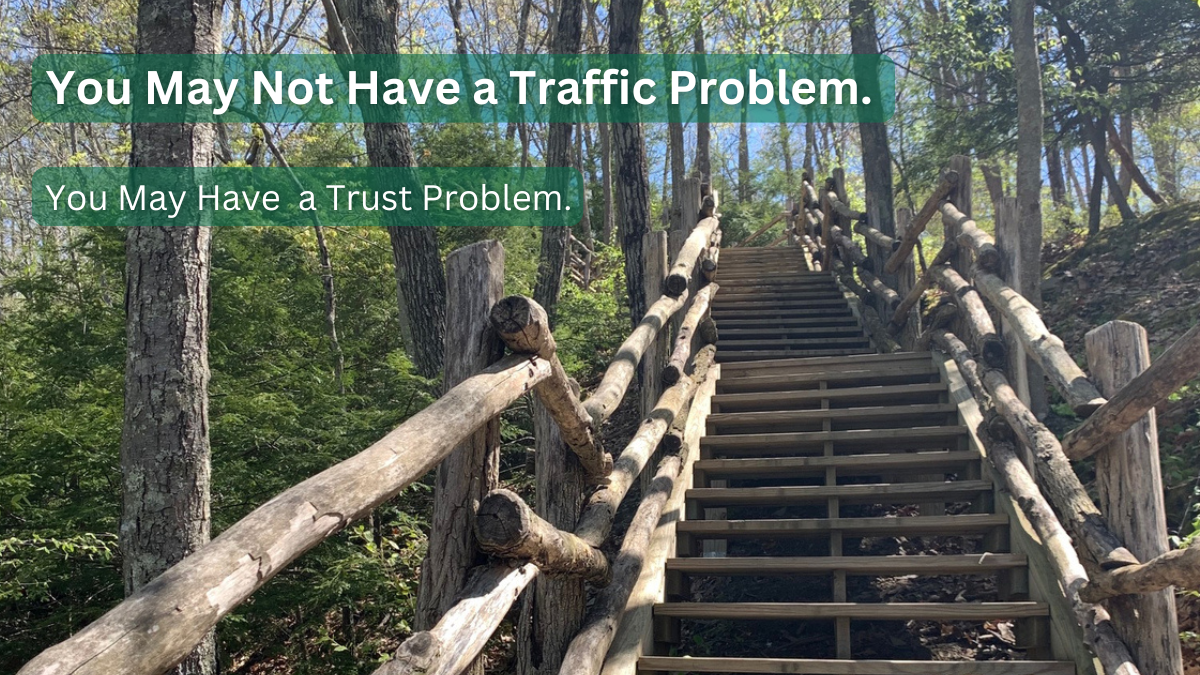
That is usually the moment when it is worth asking a harder question: Is this really a traffic problem, or is it a trust problem?
More people seeing the business will not help much if the experience still gives them a reason to hesitate.
What a Trust Problem Usually Looks Like
A lot of trust problems do not look dramatic. They’re usually pretty subtle.
People don’t usually say, ‘I don’t trust this business,’ but they can usually feel it. They stop at the homepage. They do not scroll. They do not fill out the form. They do not browse the services page. They do not return later. They keep looking elsewhere.
A trust problem usually shows up as hesitation.
Why Businesses Misdiagnose This as a Visibility Issue
That is why this kind of issue gets missed so often. Traffic is easier to count. Trust is easier to miss.
Views, clicks, followers, and page visits feel measurable. They give us numbers to look at. They give us something concrete to blame. If results feel slow, it is easy to assume the problem is visibility.
But friction lives somewhere less obvious.
It lives in the space between touchpoints. In the tone of the messaging. In the mismatch between expectation and experience. In the moment when someone lands on a page and quietly decides not to keep going.
An ad may get the click, but the landing page does not earn the next step. Social content may feel warm and personal, while the website feels stiff or unclear. A homepage may look fine on desktop but feel cluttered or overwhelming on mobile, which is exactly where most people are visiting from anyway.
That is where businesses can end up chasing the wrong fix.
They add more content. More ads. More posts. More tactics. More noise.
Meanwhile, the real issue is the experience people are having once they arrive.
Signs You May Have a Trust Problem Instead of a Traffic Problem
It can look like traffic hitting the homepage without anyone exploring further. It can look like social content getting attention but not leading anywhere. It can look like a business sounding one way on Facebook, another on Instagram, and another on its website. It can look like a page asking too much too soon, before enough confidence has been built.
It can also look like small details that quietly make a business feel less organized than it really is.
Broken links.
Wrong phone numbers.
Placeholder text left behind from a template.
A profile image that does not match the brand.
A Google Business Profile with no real reviews, weak service setup, or missing categories.
AI-generated images that do not look anything like the actual business.
None of those issues may seem huge on their own. But trust is built in micro-moments. Small inconsistencies have a way of stacking up.
That is why a business can look polished on the surface and still not feel trustworthy.
What Trust Changes That Traffic Alone Cannot
When trust is stronger, the same traffic can lead to more movement.
People stay longer. They explore more. They feel more confident about the next step. They stop doing as much interpretive work. The business feels more coherent and more believable, which makes it easier for people to move forward.
That is the part people often miss.
The goal is not just to be seen. It is to feel clear and credible enough that someone wants to keep going.
In everyday terms, trust makes a business easier to choose.
It is a little like getting to know a new friend. Or even sitting across from someone on a first date. You do not decide everything all at once. You notice signals. Do they seem consistent? Do they say one thing and do another? Do they feel genuine? Do they seem thoughtful? Do you understand who they are?
Businesses work the same way.
People are not just evaluating the service. They are evaluating the experience of moving closer to it.
Does this make sense?
Do these pieces match?
Does this feel like a real business that knows what it is doing?
Can I picture myself working with them?
If the answer keeps coming back fuzzy, more traffic is probably not the first fix.
What to Look at Before Chasing More Traffic
Before you focus on getting more people in the door, step back and look at what happens when they arrive.
Does the business feel recognizable across touchpoints?
Is it clear what the business does and who it helps?
Does the homepage make a strong first impression, or does it ask people to work too hard?
Does the next step make sense for the level of trust that exists?
Does the mobile version feel just as usable as the desktop one?
Are your links connected? Are your details accurate? Are your visuals real? Does your Google Business Profile actually support the story your website is trying to tell?
Details matter.
They shape whether someone feels like they are walking into a clean, clear space with a path forward or stepping into a room where they have to dodge clutter just to figure out where to go next.
This is not about perfection. It is about making sure the business is not quietly creating friction that increased visibility will never solve.
If people are already finding you, but something still is not clicking, the issue may not be traffic alone. It may be trust.
And that is actually good news.
Because trust problems can be uncovered. They can be clarified. They can be improved.
If your business is getting seen but not getting movement, it may be time to look more closely at what the current experience is teaching people to feel.
My Clarity Catcher™ Review helps uncover the disconnects that may be making trust harder to earn and gives you clear next steps to reduce that friction.