
A lot of service businesses worry that their content is boring.
Plumbers, septic companies, appliance repair businesses, insurance agents, bookkeepers, salons, pet groomers, HVAC companies, well drillers, flooring companies, local consultants. The list could go on.
They look at what they do every day and think, “What am I supposed to post about? It’s not exactly exciting.”
But most of the time, the service isn’t the problem. The problem is that the content is starting from the business side instead of the customer’s side.
The business is thinking, “How do I describe what we do?”
The customer is thinking, “Can you help me with this specific problem, in my area, without making this harder than it already feels?”
Those aren’t the same question.
And that’s where a lot of service business marketing gets stuck.
Customers are not usually looking for “quality service”
Almost every service business says some version of the same thing.
Reliable service. Quality work. Experienced team. Family-owned. Customer-focused. Locally trusted.
None of those things are bad. In fact, they may all be true.
But when a customer lands on your website, Google Business Profile, Facebook page, or service page, they’re usually not starting with a calm, abstract search for “quality service.” They’re often dealing with a problem.
The sink is leaking. The air conditioner stopped cooling. The washer is making a sound it has never made before. The dog needs grooming before company arrives. The insurance renewal suddenly looks more expensive. The well water smells different. The salon appointment feels overdue, but they’re nervous about trying someone new.
In that moment, “quality service” may not be enough to help them decide.
They’re trying to answer quieter, more specific questions.
Can you help with my situation? Do you serve my area? How soon can you come? Will I understand the price before I say yes? Will I feel pressured? Are you real? Can I trust you in my home, with my pet, with my hair, with my money, or with this decision? What happens after I call?
That’s where the useful content is hiding.
Not in saying more generic things about the business, but in answering the questions the customer is already carrying.
The customer’s question changes the content
Let’s say you run an appliance repair business. A basic service page might say:
“We provide reliable appliance repair for washers, dryers, refrigerators, dishwashers, ovens, and more.”
That’s clear enough as a category description. But from the customer’s side, there are still several unanswered questions.
Can you fix my brand? Is it worth repairing, or should I replace it? Do you come to my town? How soon can someone come out? Do I need to unplug anything before you arrive? Will you tell me the cost before starting? What happens if you don’t have the part?
Those questions aren’t boring. They’re practical. They’re useful. And they’re exactly the kinds of things someone may be wondering before they feel ready to call.
The same thing applies to a plumber. A plumbing website may say, “Family-owned. Reliable. Quality service.”
But the customer with water on the floor is probably not comparing brand values in that moment. They’re wondering if you can come today, if you handle emergencies, if you serve their neighborhood, what they should do right now, whether this is going to be expensive, and whether they can trust you inside their home.
That’s the difference between describing your service and helping someone make a decision.
“Boring” often means the customer’s part is missing
A lot of service business content feels boring because it skips the part where the customer sees themselves. It talks about the business, the service, the years of experience, the commitment to quality, and the list of things offered.
Again, none of that is wrong.
But if the customer can’t quickly connect that information to their own situation, the content may feel flat.
For example, a well drilling company knows exactly what a well inspection includes, while a homeowner may not. Bookkeepers understand the difference between monthly reconciliation, cleanup, and advisory support, but a small business owner may only know their numbers feel messy.
Pet groomers may know which coat types need which schedule, while a typical pet owner may just know their dog is matted and they feel embarrassed calling. A salon may offer color correction, gloss, balayage, gray blending, and deep conditioning, but a first-time client may be wondering, “Am I going to book the wrong thing?”
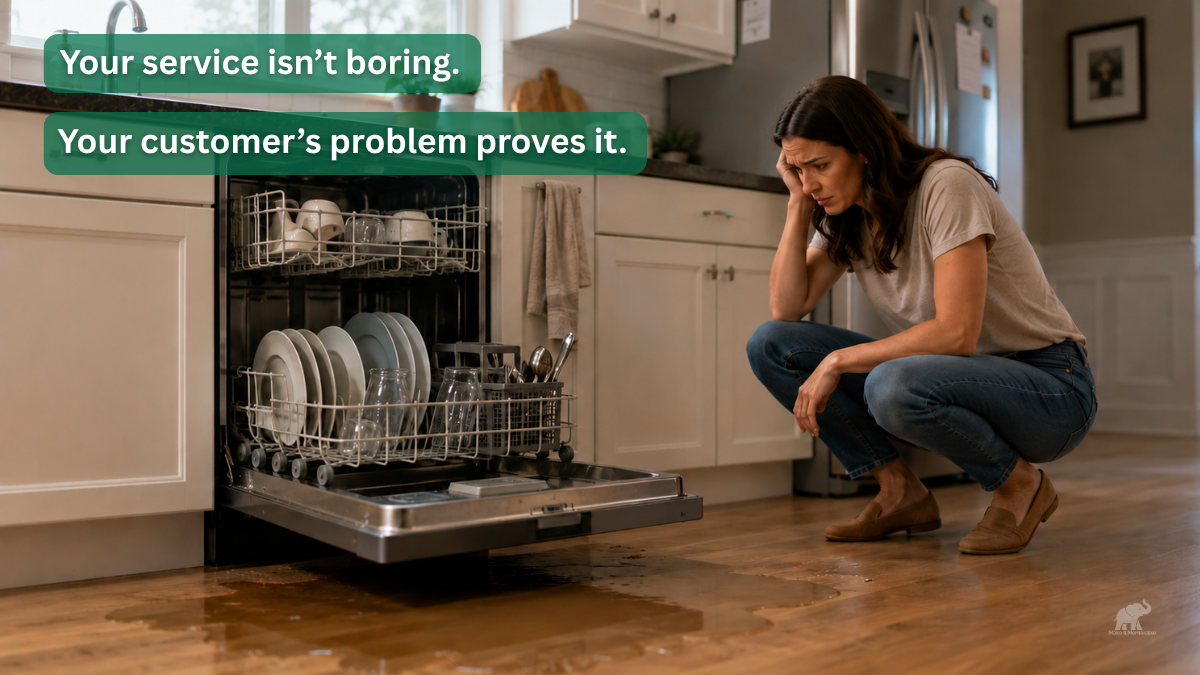
The service isn’t boring.
The missing context is the problem.
When content only names the service, it can feel generic. When it explains the situation, the hesitation, the next step, and what the customer can expect, it becomes helpful.
And helpful is rarely boring.
Service businesses have more content than they think
One of the easiest ways to find better content is to stop asking, “What should we post?”
Start asking, “What does the customer need to understand before they feel comfortable taking the next step?”
That one question opens up a lot.
For a plumber or HVAC company, content could explain what to do while waiting for help, when a small issue becomes urgent, what different sounds or warning signs might mean, or how to know whether something needs repair or replacement. For an appliance repair company, it might answer whether a problem is usually worth repairing, what information to have ready before calling, or why one brand issue may require a specific part.
For more personal services, the same principle applies. A salon can explain how to choose the right appointment type, what happens during a consultation, or what someone should know before making a big color change. Pet groomers can explain what to expect at the first appointment, how to prepare a nervous dog, or why some coat conditions require a different service.
For trust-heavy services like insurance, bookkeeping, well service, septic work, flooring, consulting, or home repair, content can help customers understand what questions to ask, what information to gather, what the process looks like, and what signs mean they may need help sooner rather than later.
None of that requires dancing, trends, or trying to make the business into something it’s not.
It just requires looking at the service from the customer’s side.
The best content often starts with a real hesitation
Hesitation is the moment where someone almost takes action, but something stops them.
They almost call, but they’re not sure you serve their town. They almost book, but they don’t know which service to choose. They almost request a quote, but the form feels like too much.
They almost trust you, but they can’t find a real photo, review, or explanation of your process. They almost decide, but the next step feels unclear.
That “almost” matters.
Because marketing doesn’t only need to get someone’s attention. It also needs to help them move forward.
For service businesses, especially local and trust-based ones, the customer is often making a decision before they ever contact you. They’re looking for small signs that they’re in the right place and that you can help with their specific need.
A customer review or two can help. So can a clear service-area list, unstaged photos, a short “what happens next” section, or a few FAQs that answer the questions people are quietly carrying. Even a simple before-and-after explanation, especially with photos when they make sense, can help someone understand the value of the work.
These aren’t flashy marketing tactics.
They’re clarity signals.
And clarity signals reduce decision friction.
Service-area confusion is a quiet lead stopper
One of the simplest examples is service-area clarity.
Many local service businesses say something like “serving the surrounding area.” That may feel obvious to the business owner because they know where they go every week.
But the customer may not know.
If they live one town over, they may wonder:
Do you come here? Am I too far away? Will there be an extra trip charge? Should I call, or will I be wasting your time?
That small uncertainty can be enough to stop someone from reaching out.
Clear service-area language is not glamorous. It’s not the kind of marketing advice that sounds exciting in a webinar. But it matters.
A simple list of towns, counties, neighborhoods, or service radius details can make the next step feel safer. It helps the customer self-identify and removes a tiny point of hesitation.
And sometimes removing tiny points of hesitation is what helps the phone ring.
Proof does not have to be perfect
Another place service businesses get stuck is proof.
They may think they need polished videos, professional brand shoots, perfect before-and-after galleries, or a full content production plan before they can show anything useful.
But proof doesn’t need to be fancy.
Sometimes proof is a real photo of the team, the truck, or a recent job. It can be a review that mentions the exact kind of problem someone else is having. It can even be a short explanation of what happens after someone fills out the contact form.
People aren’t always looking for perfection. They’re often looking for enough evidence to feel like, “Okay, this looks like a real business. They seem to understand this problem. I know what to do next.”
That is especially true when someone is inviting you into their home, trusting you with their pet, asking for help with money, trying a personal service, or making a decision they do not fully understand.
Trust starts before the first conversation.
Your content can either support that trust or leave the customer guessing.
The fix is not always more content
This is the part that matters because the answer is probably not to post more.
More content can help, but only if the path is clear enough when someone gets curious.
Before a service business creates more posts, more ads, more reels, or more website pages, it’s worth checking the customer journey.
Can people tell what you do in a few seconds? Can they understand whether you help with their specific problem? Can they find the next step without hunting? Can they understand what happens after they call, book, or request a quote?
If the answer is no, more visibility won’t fix the problem. It may simply send more people into the same confusion.
That doesn’t mean you should stop creating content. It means your content should be connected to the questions people need answered before they’re ready to move forward.
That’s where service business content becomes more useful.
And often, more memorable.
A simple way to find better content
The next time you feel like your service business is too boring to talk about, try this instead.
Pick one service you offer. Then ask:
What situation usually causes someone to need this?
What do they misunderstand about it?
What are they nervous about?
What do they need to know before they call?
What do they need to believe before they trust us?
What would make the next step feel easier?
That is your content.
Not because you’re trying to turn every customer question into a sales pitch, but because useful information helps people decide.
And when people feel less confused, less unsure, or less hesitant, they’re more likely to take the next step.
Your service probably is not boring
If you run a service business, your work may feel ordinary to you because you see it every day. But your customer doesn’t.
They may be dealing with the issue for the first time. They may not know what to ask or what is normal. They may not know how urgent the problem is or which service they even need.
That’s why customer-side clarity matters.
Your job is not just to say what you do. It’s to help the right person recognize:
“Yes, this is for me.”
“Yes, they understand my problem.”
“Yes, they serve my area.”
“Yes, I know what happens next.”
“Yes, I feel okay reaching out.”
That’s not boring.
That’s useful.
And useful content gives people a reason to trust you before they ever call or fill out the form.
Not sure what your website is making customers guess?
If your website explains what you do, but people may still be unsure whether you’re the right fit, the Clarity Catcher™ Snapshot is a simple place to start.
It helps you look at your website from the customer’s side and spot where your message may feel clear, fuzzy, or invisible.
Because sometimes the issue isn’t that your business needs more attention. Sometimes the issue is that customers need a clearer path once they find you.