
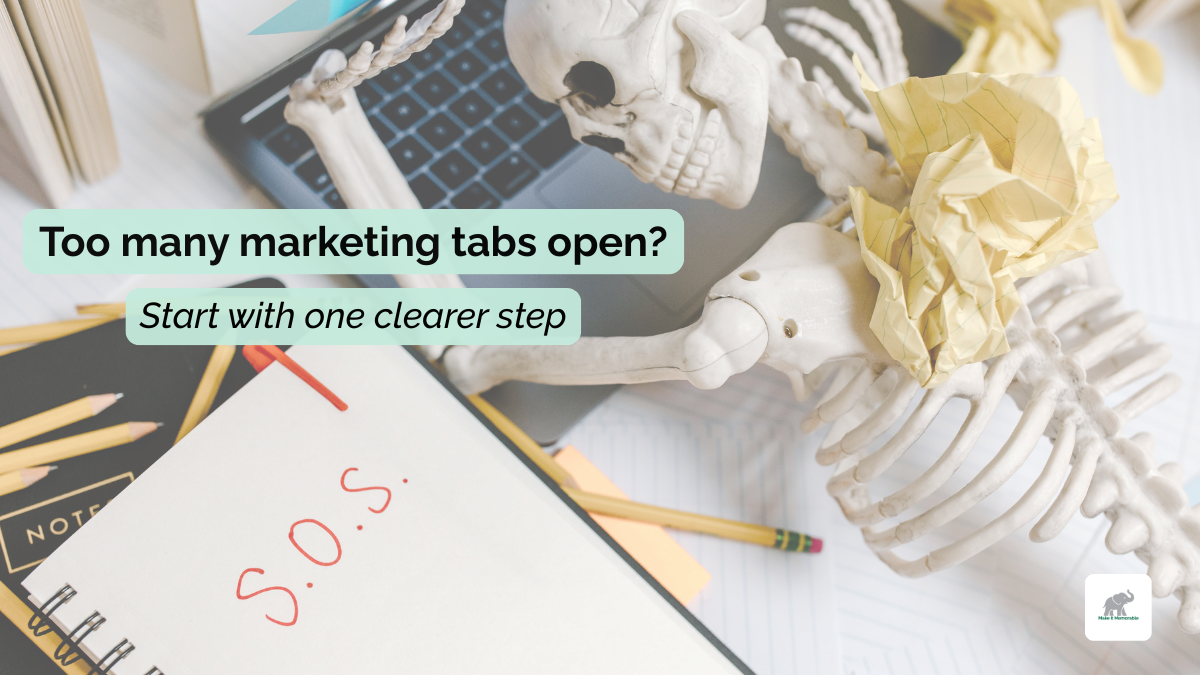
If your brain feels like it has 100 different tabs open, you may be stuck in the Overwhelmed Founder stage.
You can see where you want to go. You’re confident that your product, service, or idea has value. You may even have years of experience behind you.
But when it comes time to explain what you do, choose where to show up, fix your website, create content, build trust, track traffic, and figure out why people aren’t taking the next step, everything starts to feel tangled.
It’s not because you don’t know what to do.
It’s because too many decisions are stacked on top of each other with no clear plan for where to start first.
What Overwhelm Looks Like
Does this sound like the conversation in your head?
How many social platforms should I be on?
What should I post?
How often should I post?
What does my website need to say?
Is my Google Business Profile set up correctly?
How do I know if people are finding me?
If I can see traffic, why are visitors not moving past the first page?
Should I start a newsletter?
How do I collect email addresses if people are not even taking the free quiz, guide, or diagnostic?
How do I market something I know is valuable?
And maybe the most frustrating question of all:
Why is it so hard to explain what I do when I have been doing this kind of work for years?
If so, I see you.
And naming the tangle is often the first step toward loosening it.
Why This Happens
The real problem usually isn’t lack of effort.
Many overwhelmed founders are doing plenty. They’re posting, tweaking, researching, revising, learning, watching what other people are doing, and trying to make smart decisions.
But when the pieces aren’t connected, effort can start to feel like a traffic jam.
The website says one thing.
Social content points in several directions.
The offer feels clear in your head, but not simple on the page.
The audience is too broad.
The next step isn’t obvious.
Trust signals may be thin if the business is still growing.
Nothing is necessarily “wrong” on its own. But the pieces aren’t working together yet, and the space between them is where trust, clarity, and momentum can quietly leak out.
This Isn’t Just a Feeling
Recent small business research shows a similar pattern: effort is up, but confidence isn’t always following.
Constant Contact’s 2025 Small Business Now report found that marketing confidence among small businesses has declined to 18% globally, even as many small businesses are increasing budgets, using more tools, and trying to do more with their marketing.
That matters because overwhelm often shows up when a founder is doing plenty, but the pieces aren’t working together yet.
The trust side matters too. BrightLocal’s 2026 Local Consumer Review Survey found that 97% of consumers read reviews for local businesses, which means newer or under-reviewed businesses may need to work even harder to make the path feel clear and trustworthy.
And PwC’s Trust in US Business Survey points to a wider trust gap: 90% of business executives think customers highly trust their companies, while only 30% of consumers actually do.
In other words, clarity is not just about making marketing feel easier for the founder.
It also helps the customer feel safer taking the next step.
What Not To Do First
Don’t be too hard on yourself. This is a fairly common place for founders to land, especially when you care deeply about what you’re building.
But also, try not to respond to overwhelm by adding more.
More platforms.
More tools.
More content.
More lead magnets.
More things to track.
More things to fix.
When the path already feels tangled, adding more pieces rarely creates clarity. It usually just gives you more to manage.
That doesn’t mean those things are bad.
A newsletter can be helpful. A clearer Google Business Profile can matter. Social content can build visibility. Website traffic can teach you a lot.
But if the pieces aren’t connected yet, adding another tactic may only make the traffic jam bigger.
Before you add, pause and sort.
What To Do Instead
Start by looking for patterns.
Not every problem deserves the same amount of attention. Not every idea belongs at the top of the list. And not every marketing question needs to be answered today.
Instead of asking, “How do I fix all of this?” try asking, “What is this showing me?”
Look for:
1. What is already working?
Where are people clicking, commenting, asking questions, responding, or showing interest?
Even small signs matter. A comment, a repeat question, a saved post, a download, a website visit, or a conversation can all point toward something worth noticing.
You may not have a full strategy yet, but you may already have clues.
2. What keeps coming up?
Are people confused about the same thing?
Are you explaining the same part of your offer over and over?
Are visitors stopping in the same place?
Are potential customers interested, but not quite ready to take the next step?
Repeated friction is useful information.
It can show you where your message needs to be clearer, where your website needs a better path, or where your audience needs more trust before they are ready to move forward.
3. What feels disconnected?
Does your ad match your landing page?
Does your website match the way you talk about your work in person?
Does your social content point people toward the same core message?
Does your offer match what your audience is actually worried about?
Sometimes the problem isn’t one broken piece. It’s the space between the pieces.
That space matters.
It’s where a curious visitor can become unsure.
It’s where a warm lead can hesitate.
It’s where someone who might be a great fit decides, “Maybe later,” because the next step doesn’t feel clear enough yet.
4. Who are you really trying to help first?
If your audience is too broad, every message becomes harder to write.
You may be able to help many kinds of people, but your marketing usually needs a narrower starting point.
The more specific the first “who” becomes, the easier it is to decide what to say, where to show up, and what next step makes sense.
This doesn’t mean you can never serve anyone else.
It simply means your message needs someone specific enough to recognize themselves in it.
5. What is the next best bite?
You don’t have to eat the whole elephant today.
Choose one bite.
One page to clarify.
One offer to explain better.
One traffic source to understand.
One question to answer.
One next step to make easier.
That’s how overwhelm starts to loosen.
The Goal Is Not To Fix Everything At Once
If you’re in the Overwhelmed Founder stage, the goal is not to suddenly become perfectly organized, perfectly visible, or perfectly clear everywhere.
The goal is to stop treating every marketing question like it has equal weight.
Some pieces matter more right now.
Some can wait.
Some are symptoms of a deeper clarity gap.
And some may already be working better than you realize.
Start by naming the tangle. Then look for the thread that helps you take the next step.
The Overwhelmed Founder is only one kind of stuck. If you want the bigger picture, I shared the full five-part framework in Before You Fix Your Marketing, Name What Kind of Stuck You Are.
If you’re not sure which kind of stuck you are in, the What Kind of Stuck Is Your Business In quiz can help you name the pattern before you try to fix the pieces.
And if your homepage may be part of the tangle, the Clarity Catcher Snapshot is a simple place to start.
One bite. One clearer step. That’s how the path starts to open.