
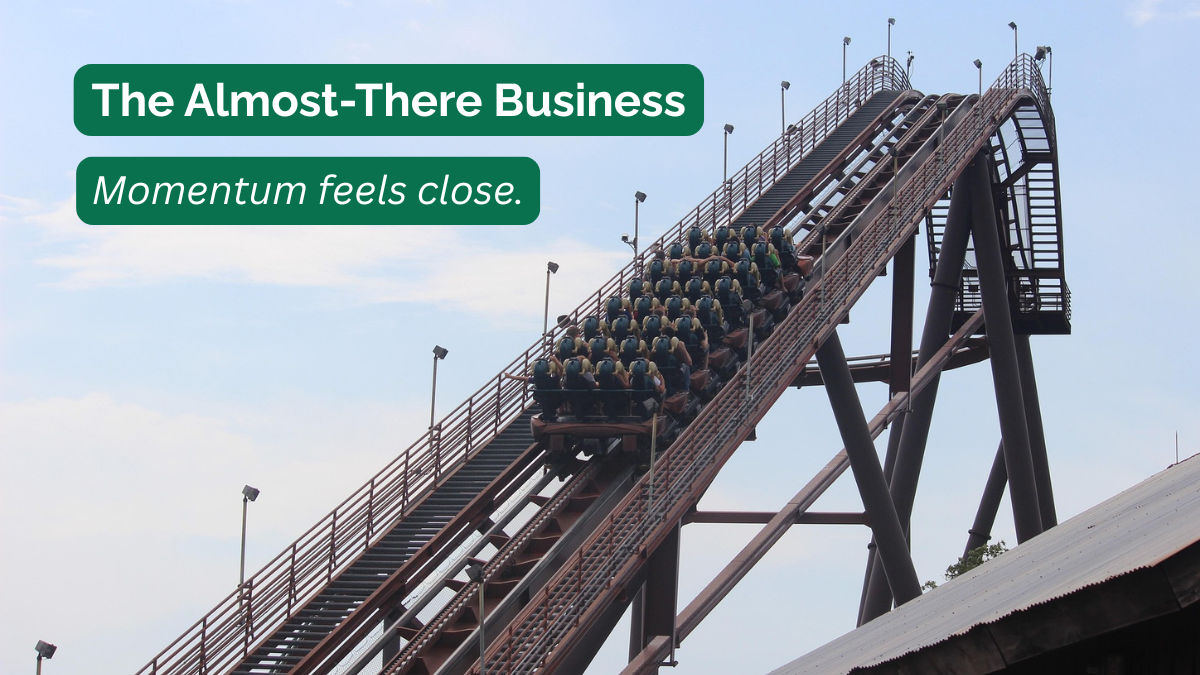
If you’re a small business owner whose marketing is getting attention but not action, perhaps you can relate to this top-of-the-roller-coaster feeling.
You can hear the clicks, feel the climb, and you know the drop is coming. You just haven’t quite reached the point where the chain lets go and the car is released.
That’s the gist of the Almost-There Business.
Your website is getting traffic. People are visiting more than one page. Your Google Business Profile is getting views. Social posts are getting likes and maybe even a few shares. People seem interested.
But the form submissions, calls, bookings, or sales are still lagging behind. They aren’t matching the level of attention you’re receiving.
So, what’s going on?
The Signals Are Real
Unlike The Invisible Business which I discussed last week, the Almost-There Business isn’t hearing crickets. There are signs that people are paying attention.
The website traffic is there. People are clicking around instead of landing on one page and leaving. Your Google Business Profile is getting views. Social posts are getting some traction. Maybe Instagram, Facebook, LinkedIn, or even email are sending people to the right place.
A few people may even be taking the first step. They fill out a form. Schedule a call. Send an email. Ask a question.
People are seeing you.
The question is: what is keeping more of them from taking action?
That’s what makes this stage tricky. The signals are real, but they aren’t the same as momentum. Attention tells you people are noticing. It doesn’t always tell you they feel ready, reassured, or clear enough to move forward.
Why Almost Working Feels So Frustrating
The hardest part about this stage is that nothing looks noticeably wrong, at least from your point of view as the founder.
You’re not starting from zero, guessing blindly, or imagining the interest. But since the business is getting some positive signals, the lack of conversions feels even more confusing.
You may wonder:
Why are people looking but not contacting me?
Why did they visit three pages and disappear?
Why did they like the post but never book?
Why did they schedule a call, then stall afterward?
Why does this feel so close, but still not quite working?
Almost working can feel more frustrating than not working at all because the signs are real, but the outcome still hasn’t caught up.
That’s usually the moment when it’s tempting to do more, when what you may really need is to look closer.
Where The Hesitation Hides
The sticking point usually isn’t a big red flag blowing in the breeze. It’s often a small disconnect that quietly creates hesitation. And because you’re close to the business, that disconnect may not stand out to you at all.
It could be something “simple” like:
A broken link on a social profile.
A button that goes to the wrong page.
A contact form that feels too long.
A services page that explains what you do, but not what happens next.
A booking process that feels cold or confusing.
A follow-up email that overwhelms instead of reassuring.
A call-to-action that sounds vague.
A website that builds interest, but does not answer the buyer’s final concern.
This is especially important for businesses that sell trust, care, organization, precision or attention to detail. If your business promises to be organized, thoughtful, precise, or detail-oriented, the little details become part of the trust test.
Small disconnects can create more hesitation than you realize.
The Gap May Be in the Second Step
Yes, you read that correctly – the second step.
Most people focus only on getting the click, the visit, the form submission, or the scheduled calls. But sometimes the gap happens after the first yes.
Sometimes the first step works because people understand the immediate offer. But once they raise their hand, the path beyond that first step gets fuzzy. The website may be the hub, but the spokes still matter. Where do they go next? What do they receive? What should they expect? What other touchpoints help them feel confident instead of uncertain?
What does this look like? It can show up in several ways:
- Someone submits a form, but the reply wasn’t fast enough.
- A confirmation is sent after a call is scheduled, but it doesn’t help them feel prepared for what to bring or what will be discussed.
- A prospect asks for pricing, but the response gives too much information too soon instead of first clarifying what they actually need.
- Someone expresses interest, but there’s no simple next step.
- A follow-up is sent, but it accidentally creates more decisions instead of fewer.
Some People Are Interested, But Not Ready Yet
It’s important to remember that not every delay means something is wrong.
Some people are still gathering information and just aren’t ready quite yet. They’re comparing options. Researching finer details. Deciding whether to trust you.
And that behavior is more common than you might think. BrightLocal’s 2026 Local Consumer Review Survey found that after reading positive reviews, consumers are more likely to keep researching than buy or book right away. In fact, 66% do more research, while 34% are ready to buy or make a booking. Many visit the business’s website or social media before deciding what to do next.
So, if people are visiting, browsing, and circling back, that may be a sign of interest. It just may not be the tipping point yet.
They may need a trigger event before they move from interested to ready. The problem hasn’t become urgent enough to act yet.
In this instance, the answer isn’t to chase them harder. It’s to keep showing up clearly, consistently, and helpfully.
You cannot force the trigger moment, but you can make sure your business is easy to trust when that moment arrives.
What To Look At Next
Diagnosis is the key. Rather than posting more, redesigning landing pages, running more ads, or lowering prices, ask yourself these essential questions:
Where are people showing interest?
Where are they stopping?
What questions are they asking before they pause?
What page do they visit before leaving?
What happens immediately after they submit a form or book a call?
Is the next step obvious?
Does the follow-up simplify the decision or complicate it?
Is there one small trust gap causing people to wait?
The goal isn’t to add more marketing noise. The goal is to find the hesitation point, reduce the friction, and make the next step feel safer, clearer, and easier.
If this sounds familiar, your business may not need a complete marketing overhaul. You may just need to find one place where interest is turning into hesitation. Start with one hesitation point. Fix that first. Then look for the next one.
That might be your website customer journey path.
It could be your offer clarity.
It might be your follow-up or your booking process.
It might simply be that people need more time and more consistent trust-building before they’re ready.
But you don’t have to guess forever.
Take the free Find Your Stuck Type quiz, or schedule a free 30-minute clarity call. Let’s look for the gap together.